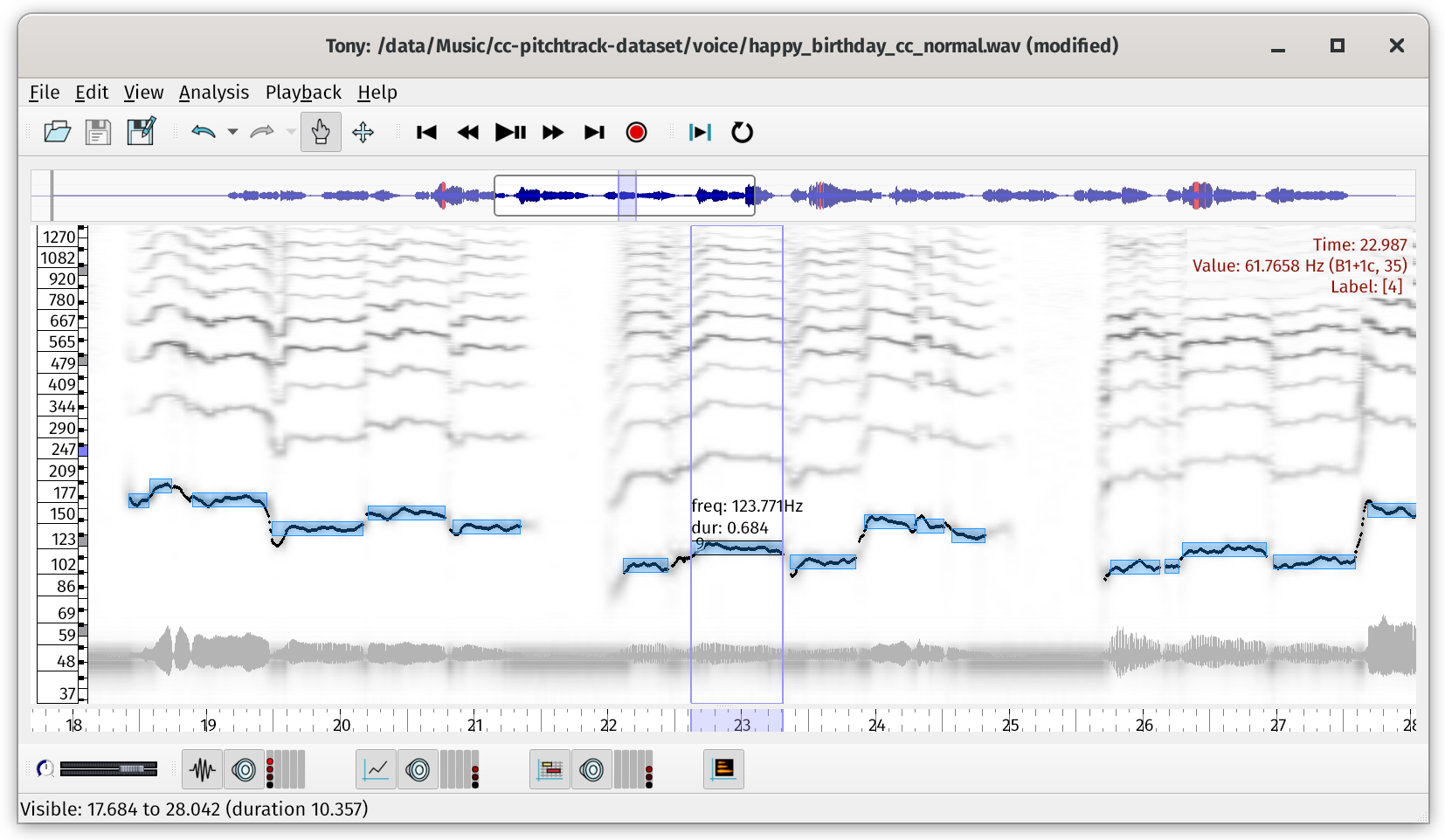
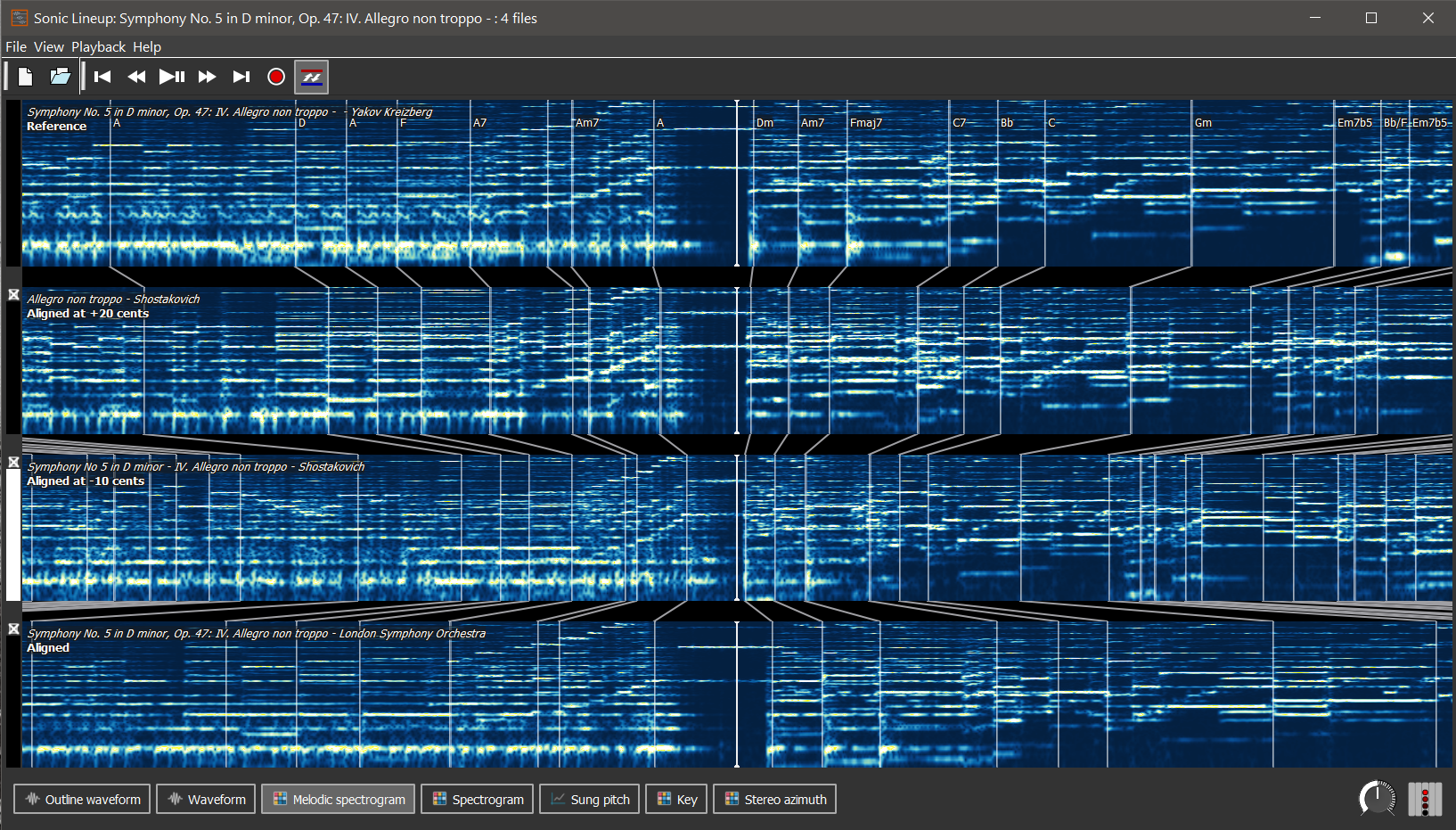
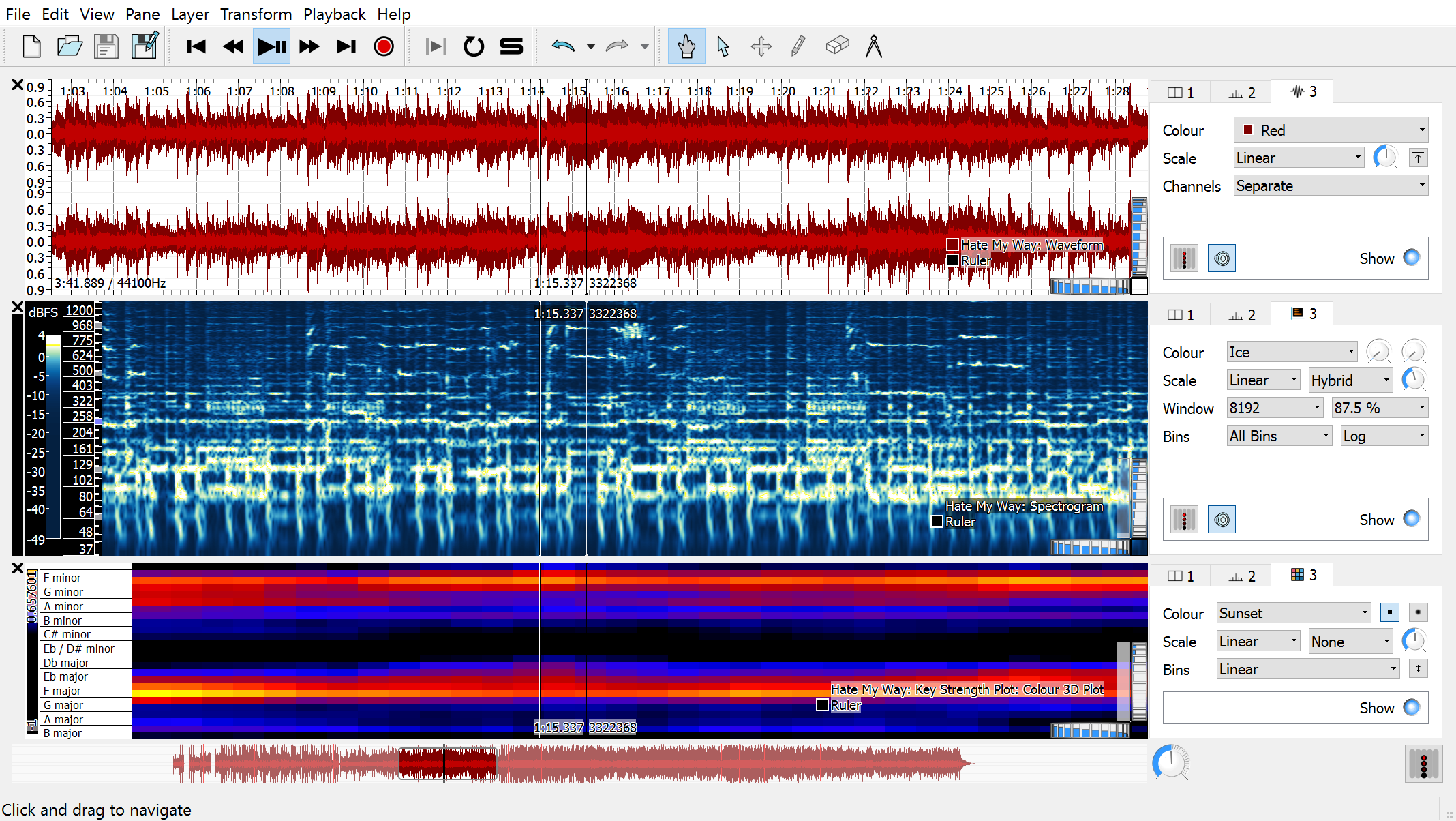
Sonic Visualiser is a free, open-source application for Windows, Linux, and Mac, designed to be the first program you reach for when want to study a music recording closely. It's designed for musicologists, archivists, signal-processing researchers, and anyone else looking for a friendly way to look at what lies inside the audio file.
Sonic Visualiser version 5.2.1 was released on 21 March 2025. Download it here!
Sonic Visualiser is one of a family of four applications:
Citations: If you are using Sonic Visualiser in research work for publication, please cite (pdf | bib) Chris Cannam, Christian Landone, and Mark Sandler, Sonic Visualiser: An Open Source Application for Viewing, Analysing, and Annotating Music Audio Files, in Proceedings of the ACM Multimedia 2010 International Conference.
Most physics students first encounter group theory via an appendix in a quantum mechanics book (covering SU(2) and SO(3)). They then jump to a specialized text. Tung's book bridges the gap. Here is what makes it exceptional:
Are you studying this for a (like Particle Physics or Quantum Computing)?
The roadmap of Tung’s book mirrors the journey a theoretical physicist takes from foundational mechanics to advanced quantum field theory. 1. Fundamentals of Group Theory and Vector Spaces Wu-ki Tung Group Theory In Physics Pdf
Unlike many competing texts that focus solely on SU(N), Tung dives deeply into the Lorentz group (SO(3,1)) and its covering group SL(2,C). He explains two-component spinors and four-component Dirac spinors from a group-theoretic origin, showing exactly how the Dirac equation emerges from the representation theory of the Lorentz group.
Tung’s book is not a one-week read. It is a book you will keep on your shelf—physical or digital—for decades. The derivations of the Casimir operators of SO(n), the careful discussion of the universal covering group, and the tables of representation dimensions are reference material you will constantly revisit. Most physics students first encounter group theory via
(approx. ₹1,500 for paperback), various digital formats exist for academic use: Group Theory in Physics - World Scientific Publishing
The fundamental geometry of our universe is governed by the Lorentz and Poincaré groups, dictates how objects behave under rotations, boosts, and translations. Here is what makes it exceptional: Are you
"Wu-ki Tung Group Theory in Physics PDF" is more than just a search term; it represents the desire to access a foundational work that has educated generations of physicists. Wu-Ki Tung's book remains a gold standard for its pedagogical clarity, its balanced treatment of mathematics and physics, and its comprehensive coverage of essential physical symmetries. While finding a legitimate digital copy requires navigating several channels, the effort is worthwhile. For any serious student of theoretical or mathematical physics, engaging with Tung's work is not just an academic exercise—it is a rite of passage into a deeper understanding of the beautiful and systematic order underlying the laws of nature.